

Best PTFE Sheets Manufacturer Qualities You Should Look For
2026-09-04
If you've ever had a PTFE sheet fail under pressure, you know the manufacturer matters more than the spec sheet. But what separates a reliable supplier from a risky one? At Kaxite, we've seen the difference firsthand—and it boils down to a few critical qualities you can't afford to overlook.
The resin lot is traceable, not just claimed as virgin
Every batch of resin we use carries a full chain-of-custody record. That means you can trace the material back to its original production run, including the date, location, and even the specific reactor it came from. It is not a vague promise or a rubber-stamped certificate; it is a verifiable trail we are happy to share.
When a supplier claims virgin resin, that word alone tells you very little. A lot number that can be pulled up in a database, checked against QC logs, and matched to shipping documents tells you far more. We keep those records on file and make them available to customers who ask, because traceability is not about marketing language — it is about proving what went into the product.
Contamination or regrind sneaks in when nobody is watching the pipeline. Our lot-level traceability closes that gap. You will know exactly what you are getting, down to the raw pellet history, without having to take our word for it.
Thickness readings stay tight from the first sheet to the last
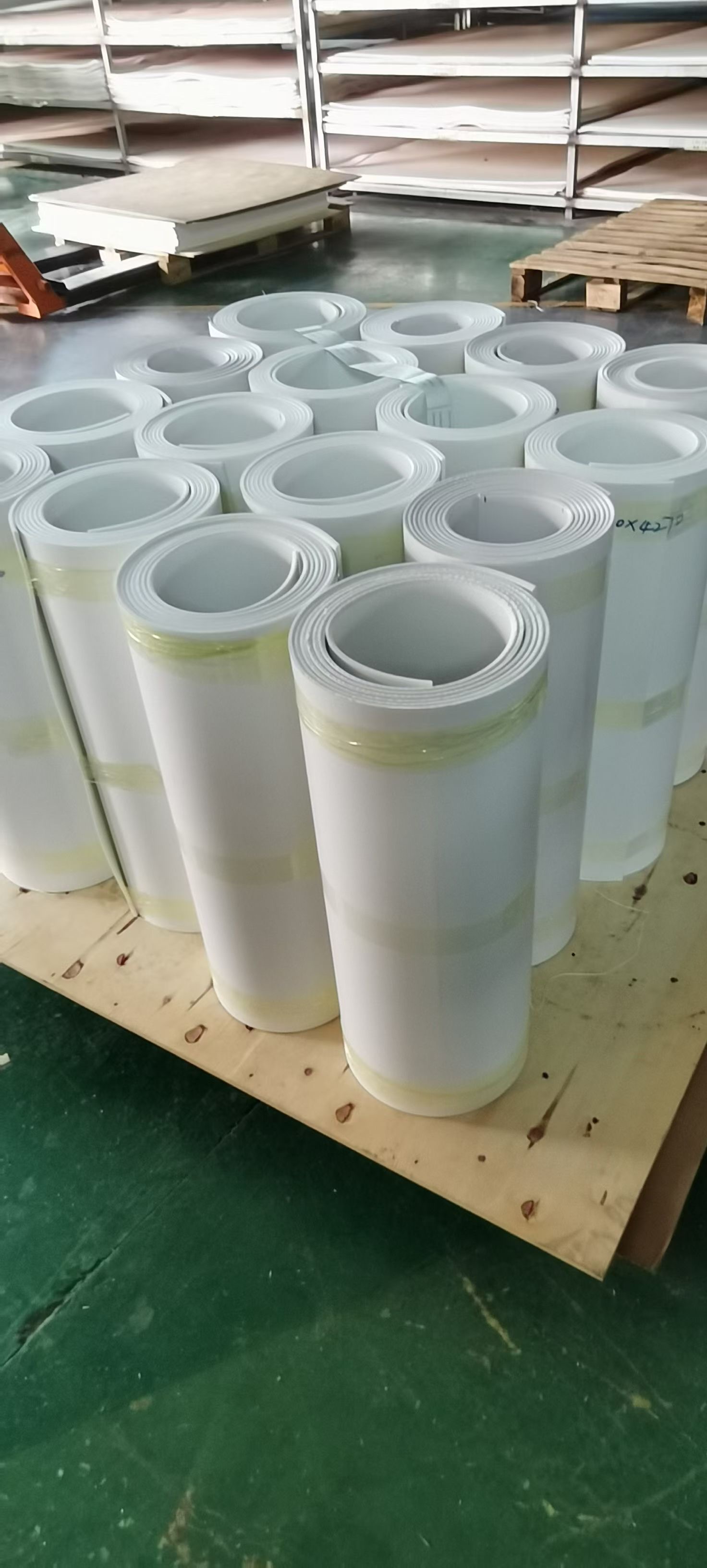
Operators often watch the first few sheets closely, then trust the process. Here, the numbers don't drift. Thickness readings stay tight from the first sheet to the last, with no gradual falloff or sudden spikes as the run progresses.
That kind of stability matters more than a single impressive measurement. When every sheet reads within the same narrow band, downstream cutting, coating, and stacking run smoother, and scrap rates drop without constant manual adjustment.
The consistency isn't a lucky batch. It holds across shifts and material lots, so the line keeps producing uniform sheets without needing recalibration or rework.
Custom sizes and skived rolls arrive before your line stops
Downtime is not in your production plan. When standard roll dimensions won't fit your application, waiting for custom-sized material can become a bottleneck. Our custom sizing service eliminates that delay by cutting rolls to your exact width and diameter before they ship. You receive material that drops straight onto your line, not a stopgap that requires additional handling.
Skived rolls add another layer of readiness. The skiving process bevels the leading edge, so the splice passes smoothly through rollers and tension zones without snagging. For high-speed lines or thin substrates, that edge preparation is often the difference between a clean start and a torn web. We treat skiving as a standard option, not a special request, which means your order moves through production without extra lead time.
What matters is that the material arrives when you need it, in the form you can actually run. Custom sizes and skived edges are not afterthoughts—they are part of the order from the first step. That keeps your line moving, your changeover short, and your throughput predictable.
Test certificates carry real lab data, not boilerplate
Every test certificate includes the exact numbers recorded during physical testing—tensile strength, elongation, hardness, or chemical composition. These values come directly from calibrated instruments on the specific sample batch, not from a pre-filled template.
Boilerplate documents often show generic placeholders or copied results from unrelated heats. A real certificate, by contrast, carries a unique lab report number, test date, equipment ID, and raw measurement logs. This lets engineers trace every figure back to the actual test run and make confident material acceptance decisions.
The surface is finished for your process, not a generic gloss
A gloss finish tells you nothing about how the surface will behave under your specific tooling, temperatures, or throughput. So instead of stopping at a standardized shine, the final pass is tuned to the way you actually run. If your process relies on low-friction release, the surface gets a controlled micro-texture rather than a mirror polish. If cleanability drives your uptime, the peaks and valleys are minimized in a different way than what a generic spec would call for.
That means the same material can leave here with a dull, almost matte appearance for one line and a bright, reflective face for another. The difference isn't cosmetic preference; it's measured against pull-off force, wear patterns, or particle entrapment you've seen on your floor. Generic gloss treats all applications as if they share one fingerprint. Yours doesn't, so the final surface doesn't either.
You can talk to an engineer who actually understands PTFE
Most suppliers hand you a spec sheet and hope that's enough. We prefer you get the person who machined your parts, tested the thermal cycling, and knows why a particular grade of PTFE creeps under load at 260°C. That conversation usually starts with "What are you actually trying to do?" and ends with a design that works in the real world, not just on paper.
PTFE has quirks—cold flow, high thermal expansion, a tendency to pick up contaminants in some processes. A generic support line won't catch those. Call us, and you're likely to reach someone who has seen PTFE fail in unusual ways and can steer you toward filled compounds, modified sintering cycles, or a different geometry before you waste money on prototypes.
It's the difference between talking to a script and talking to an engineer who trusts your constraints. No runaround, no waiting for a callback from a product manager. Just direct answers on tolerances, surface finish, chemical compatibility, and whether PTFE is even the right call for your application.
FAQ
Ask whether they offer virgin-grade material and request a breakdown of resin sources. A trustworthy shop will be upfront about using only first-run PTFE resin, not regrind or blended stock, and should provide certificates of analysis for each batch instead of pointing to generic marketing claims.
PTFE is often machined into gaskets, seals, and insulators where a few thousandths of an inch can change compression, creep, or dielectric performance. If thickness wanders across the sheet, you end up sorting parts or adjusting downstream processes, which quietly eats up any savings from a cheaper quote.
Look for a certificate of conformance with each shipment, plus traceability back to the resin lot. If they also include actual test results for density, tensile strength, and elongation instead of only claiming “standard values,” that usually signals a more disciplined production line.
Yes, because fillers such as glass, carbon, bronze, or graphite change wear, thermal conductivity, and creep resistance. A capable maker should help you select the right filler percentage for your operating conditions rather than just selling what is on the shelf, and they should verify dispersion so the sheet does not have soft or brittle spots.
Request a sample batch from an actual production run, not a hand-picked coupon. Then measure thickness at multiple points, check surface finish under oblique light, and cut or machine a test piece. Consistency across several sheets tells you more about their in-process controls than any certificate on the wall.
A dull or chalky surface, uneven color, excessive voids after skiving, or a price that seems too low for virgin material often point to lower-grade resin or recycled content. Reliable makers are usually willing to explain their resin source and reject criteria, while vague answers are a warning sign.
It matters if you regularly convert sheets into specific parts. Being able to order non-standard widths, longer rolls, or precise thicknesses without paying heavy setup fees reduces waste and handling. It also shows the manufacturer has flexible production scheduling rather than only pushing stock sizes.
Conclusion
A PTFE sheet supplier worth keeping rarely talks about "virgin" resin in the abstract. They hand you the lot number, the incoming inspection record, and the date the resin arrived, so you can walk that material all the way back to the reactor if a process suddenly drifts. That same attention to detail shows up in thickness. I've seen sheets vary by a few thousandths from the first panel to the last, and that kind of consistency means your gaskets or seals don't behave differently at the end of a run. When you need a non-standard width or a skived roll cut to an unusual length, the best shops don't treat it as a special favor. They quote it fast, ship it before your line has a chance to stop, and pack it so it arrives flat and clean.
But raw material and dimensional control are only half the story. Ask for a test certificate; the ones that matter show actual measured tensile strength, elongation, and specific gravity from the batch you're buying, not a copied table that could belong to anyone. Look at the surface, too. A generic glossy finish might look nice in a brochure, but if your process needs a controlled roughness for bonding or a specific texture for release, the manufacturer should finish the sheet to your specification, not theirs. Finally, pick up the phone. If the person on the other end can discuss creep, cold flow, or why skived sheet behaves differently from molded, you're talking to a supplier who actually understands PTFE. That combination of traceability, consistency, and real engineering support is rare, but it separates a vendor from a partner.
Contact Us
Contact Person: Kaxite
Email: [email protected]
Tel/WhatsApp: 0086-574-87527771
Website: https://www.seal-china.com