

Bulk Calcium Chloride 77% Prills: The Ultimate Buyer’s Guide for Industrial and Commercial Use
2026-11-16
Calcium chloride 77% prills are a workhorse in industrial and commercial operations, yet too many buyers settle for inconsistent quality or hidden moisture content without realizing it. Whether you’re managing ice control, dust suppression, or concrete acceleration, the difference between a reliable bulk supply and a costly headache often comes down to supplier transparency. Shouguang Golden Chemical has built its reputation on precisely that — delivering prills that meet spec, load after load. In this guide, we’ll cut through the jargon to show you what truly matters when sourcing bulk calcium chloride, from purity benchmarks to logistics pitfalls, so you can buy with confidence instead of crossing your fingers.
Why 77% Prills Beat Flake and Liquid Calcium for Heavy-Duty Jobs
Contractors who handle bulk de-icing and dust suppression keep coming back to 77% prills for one simple reason: they behave predictably when the pressure is on. Flake calcium tends to bridge and clump in hoppers, forcing operators to stop and break up blockages. Liquid calcium adds water weight to every load and freezes in cold storage unless you pay for heated tanks. Prills flow freely from the first scoop to the last, even after sitting in a trailer overnight.
On a high-traffic road or a mining haul road, coverage has to be uniform or you get streaks of ice and dust. Flake spreads unevenly because its irregular shape catches the wind and piles up in low spots. Liquid drips off the surface before it can react, wasting product. The round, dense prill lands where you aim it, dissolves at a controlled rate, and keeps working long after flake has washed away. That matters when a shutdown for re-application costs more than the material itself.
There's also the question of what you're actually paying for. Flake is roughly 77% calcium chloride too, but it arrives with more fines and dust that end up in the air or on the ground instead of doing the job. Liquid is mostly water, so you're hauling and handling a lot of dead weight. Prills give you close to pure active ingredient in every bag, with less mess, lower corrosion on equipment from spilled brine, and fewer return trips to the yard.
Spotting Fertilizer-Grade Contaminants Before They Reach Your Site
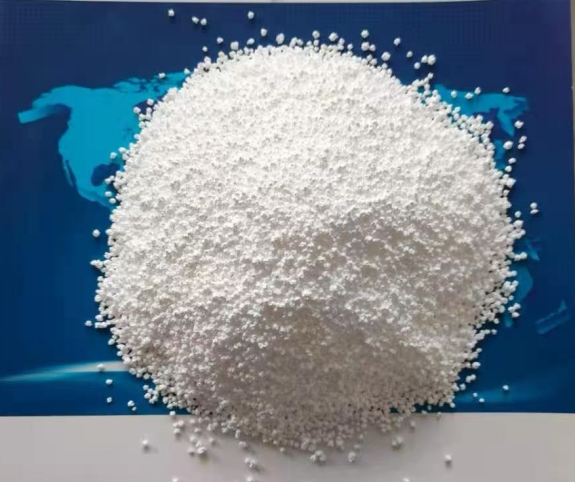
Catching contaminants at the receiving dock is far cheaper than discovering them after a batch has been blended or spread. A quick visual sweep of incoming trucks can reveal torn liners, rust flakes from hopper bottoms, or plastic shreds mixed into bulk loads. These early cues often point to handling problems upstream, and flagging them before unloading prevents contaminated material from entering your storage bins.
Requesting a pre-shipment sample from the supplier adds another layer of protection. Run the material through a 10-mesh screen to spot oversized agglomerates, glass shards, or metal fragments that a visual check might miss. If your site handles high-volume shipments, a handheld XRF analyzer can screen for heavy metals like lead, cadmium, and arsenic in under a minute, giving you a pass/fail reading before the truck backs up to the pit.
Set clear rejection thresholds for common contaminants, and share them with your logistics team so drivers know what will be turned away. Simple tools such as a moisture probe and a bucket sieve can catch caked fines or foreign pellets that alter nutrient distribution. The goal is not to test every gram, but to create a consistent front-line routine that stops problem loads before they become a storage or blending issue.
Calculating True Cost Per Ton After Freight and Moisture Loss
A supplier’s invoice price per ton is rarely the number that actually hits your cost sheet. Freight adds a direct charge per delivered ton, while moisture loss shrinks the usable weight you paid for. To calculate true cost per ton after both factors, start with the as-received price and the per-ton freight rate, then add them together. That combined amount is what you paid for every wet ton that arrived at your facility.
Next, convert that wet ton cost to a dry ton basis. If a load carries 12% moisture, only 88% of each ton is dry material, so you divide the combined wet ton cost by 0.88. The formula is: (quoted price per wet ton + freight per wet ton) / (1 - moisture content as a decimal). For example, a $95 product cost plus $18 freight equals $113 per wet ton; at 12% moisture, true cost per dry ton is $113 / 0.88, or roughly $128.41.
The most frequent mistake is applying the moisture adjustment only to the product price and not to freight, which understates the true cost. Also watch for spot moisture readings that differ from the contract average, because a few wet loads can shift your weighted cost per dry ton noticeably. Whenever you compare two suppliers, make sure every number sits on the same dry-weight basis.
Storage Habits That Keep Bulk Prills Free-Flowing All Year
Moisture is the main reason prills clump into stubborn bricks, so the first rule is to keep the storage area as dry as possible. A simple dehumidifier or a few silica gel packs placed near the bags can pull excess humidity from the air before it reaches the product. If you use a bin or hopper, check the seals regularly and wipe down any condensation you see on the inside walls. Even a small gap can let damp air in overnight and undo weeks of careful handling.
Airflow matters just as much as dryness. Stacking bags tightly against a wall or piling them too high traps heat and moisture in the middle. Leave a few inches of space between the bags and the wall, and rotate your stock so the oldest material gets used first. For larger quantities, consider a vented tote or a container with a breathable liner. Stagnant air is a quiet enemy — it encourages caking even when the room feels comfortable to you.
Finally, keep temperature swings to a minimum. Prills stored in a shed or warehouse that gets hot during the day and cold at night will sweat, and that surface moisture is enough to start fusing them together. If you can't control the climate, insulate the storage area or move the prills to a shaded, stable corner. A cheap thermometer with a humidity readout will tell you more than guesswork, and a quick check once a week can catch problems before they turn a free-flowing pile into a solid mass.
Matching Purity and Screen Size to Concrete, Ice Melt, or Dust Control
Purity and screen size rarely get the same attention as application rate, but they decide whether a product actually works. A concrete mix demands a specific particle distribution to fill voids without throwing off the water-to-cement balance. Slightly lower purity might be acceptable if the contaminants are inert, but the wrong screen size can weaken the entire pour.
Ice melt products follow a different logic. Larger, more uniform granules tend to bore through snow and ice steadily, while finer material washes away too quickly or clumps in storage. Purity matters here as well: impurities can leave behind a sticky residue or accelerate corrosion on nearby metal. Matching both factors to winter conditions prevents over-application and complaints about damaged surfaces.
For dust control, fine particles are often the better choice because they spread evenly and bind loose surface material. However, high purity is non-negotiable when the product will be exposed to water runoff or vegetation. A granular product with too many foreign particles can create a muddy layer instead of stabilizing the road. Testing a small area first remains the simplest way to confirm the match before scaling up.
Questions to Ask a Supplier Before Signing a Bulk Contract
Before you commit to a bulk order, press the supplier on how they handle sudden demand spikes. Many contracts fall apart because a vendor promises weekly output that only works on paper. Ask for their actual production capacity during their busiest month, not their average. If they can't show you a schedule with buffer time built in, that's a red flag.
You'll also want to get very specific about quality checks and defect resolution. Who inspects the goods before they leave the warehouse? What happens if a percentage of the shipment arrives damaged or below spec? Make sure the contract spells out a timeline for replacements or refunds, and don't accept vague language like "reasonable efforts."
Finally, ask about their raw material sources and backup plans. A supplier that relies on a single vendor for key components can take you down with them. Request a list of their top three suppliers for any critical material, and find out whether they've ever had to switch sources mid-contract. The answer will tell you more than any certificate.
FAQ
The 77% figure refers to the minimum calcium chloride content by weight; the rest is mostly water of crystallization and a small amount of alkali metal chlorides. That concentration gives you a practical balance between melting power, handling characteristics, and freight cost. Going higher means you are paying to ship less water, but material above 80% tends to absorb moisture faster and can turn sticky. Staying at 77% keeps the product free-flowing in most storage setups while still delivering strong performance for ice melting, dust control, and concrete work.
Prills are spherical granules that resist caking and spread evenly with mechanical spreaders, which makes them the go-to for large surface areas like parking lots, highways, and mine roads. Flake has a faster dissolution rate but creates more dust and is harder to calibrate in spreaders. Liquid is convenient for continuous injection or pre-wetting but you are paying to ship water and need heated storage in cold climates. If your crew is already set up for granular spreading and you want lower handling loss, 77% prills usually win.
Keep them in a dry, covered area with good airflow and off concrete floors that can sweat. The product will draw moisture from the air, so open bags or torn supersacks should be used first or resealed. Do not store near strong alkalis, oxidizing agents, or food-grade materials. Ideal storage temperature is between 0°C and 40°C. If you receive a full truckload, rotate stock so older material gets used before new deliveries, and inspect for clumping around the edges of the pile.
That depends on temperature and surface condition, but a common starting rate is 20 to 40 grams per square meter for light ice or frost. At -10°C to -15°C you may need 50 to 80 grams per square meter, and below -20°C the product becomes less effective as a standalone melter. Pre-wetting the prills with a liquid chloride brine can cut the granular rate by 30% and speed up melting. Always calibrate your spreader on a known area before a full run.
The same 77% prills are widely used for dust suppression on unpaved roads, where the hygroscopic nature pulls moisture from the air and keeps fines from becoming airborne. They also serve as a concrete set accelerator in colder weather, a brine base for oil and gas drilling fluids, a tire ballast for agricultural equipment, and a desiccant in packaging or air drying systems. For each use you need to confirm the particle size and purity requirements with your supplier, because some applications are more sensitive to trace sodium chloride.
Yes, calcium chloride is corrosive to unprotected steel and aluminum. Spreaders, conveyors, and storage bins should be made of stainless steel, fiberglass, or epoxy-coated steel. Wash down equipment after each shift and apply a corrosion inhibitor to metal surfaces. Also be aware that runoff from large de-icing operations can damage vegetation and concrete if over-applied, so use containment or drainage planning for high-volume sites.
Ask for a certificate of analysis from a recent production lot showing actual calcium chloride content, moisture level, and particle size distribution. Verify the supplier can handle your delivery schedule and has backup logistics for winter peaks, because shortages are common in December and January. Request a sample of the prills to test for dust, caking, and spreader performance. Also compare whether the price includes freight, pallets, and returnable packaging, since those can swing the landed cost by 10 to 15 percent.
Conclusion
For industrial and commercial operations that demand reliable performance, bulk calcium chloride 77% prills offer a distinct edge over flake or liquid alternatives. The prill form resists caking, dissolves at a controlled rate, and handles heavy-duty deicing, dust suppression, and concrete acceleration with far less mess. However, not all 77% material performs the same. You need to verify screen size distribution to match your intended use—finer prills for rapid brine production, coarser ones for slow-release ice melt. Equally important is checking for fertilizer-grade contaminants like magnesium chloride, sodium chloride, or organic residue, which can quietly sabotage concrete set times or leave unsightly residues. Before comparing quotes, calculate the true cost per ton by factoring in freight rates, typical moisture loss during transit and storage, and any spoilage from clumping. A cheap delivered price often hides shrink and reduced effective strength.
Long-term performance also hinges on how you store the prills. Keep them in sealed, moisture-resistant silos or supersacks, off the ground, and away from high-humidity areas; even minor moisture ingress turns free-flowing prills into a hard mass. Rotate stock with first-in, first-out discipline and schedule deliveries to match seasonal demand, not speculative inventory. When evaluating suppliers, ask for a certificate of analysis that lists both calcium chloride content and the levels of sodium, magnesium, and insoluble matter. Request a sample from the actual production lot, not a lab prototype, and confirm their ability to hold pricing and delivery windows for the contract term. Finally, clarify who bears responsibility for moisture loss claims and what recourse exists if the product arrives out of spec. A buyer who pairs these storage habits with hard supplier questions will consistently get better field results and fewer surprises.
Contact Us
Contact Person: Tom Cui
Email: [email protected]
Tel/WhatsApp: +8618663670626
Website: https://www.jinjigoldenchem.com