

China Waste Tire Recycling Line Converts Discarded Tires into High-Value Materials
2026-09-06
Every year, millions of tires end up in landfills, but in China, a quieter revolution is turning that waste stream into a resource stream. SFC's waste tire recycling line doesn't just shred rubber—it extracts carbon black, steel wire, and oil fractions that rival virgin materials. Curious how a discarded tire becomes a high-value commodity? Here's the inside story.
Where China's Discarded Tires Actually End Up
Most of China's discarded tires never reach a landfill. They are collected by a sprawling network of middlemen who sell them to shredding plants concentrated in Shandong, Hebei and Guangdong. There, the rubber is ground into crumbs and powder that end up in running tracks, playground surfaces, modified asphalt and even shoe soles. A smaller but steady fraction goes to retreading workshops, where truck and bus tires get a second life with new treads, especially in provinces with heavy freight traffic.
A growing share flows into pyrolysis operations, mainly in Henan, Shanxi and parts of the Yangtze River Delta. In these plants, tires are heated without oxygen to break down into fuel oil, carbon black and steel wire. The oil is sold to local factories, the carbon black returns to rubber and plastics production, and the steel is recycled. Older, small-scale pyrolysis units have a reputation for dirty emissions, but newer facilities with scrubbers and sealed reactors are quietly expanding, driven by cheap feedstock and demand for recovered fuel.
Not every tire follows a clean path. In rural areas, stockpiles still accumulate beside highways or in dry riverbeds, sometimes catching fire and smoldering for weeks. Some used tires are exported to Southeast Asia and Africa, where they are retreaded again or cut into sandals, ropes and dock bumpers. Others are simply dumped in ravines or mixed with construction waste, a sign that enforcement varies sharply from one county to the next.
Mechanical Shredding and Separation into Rubber, Steel, and Fiber
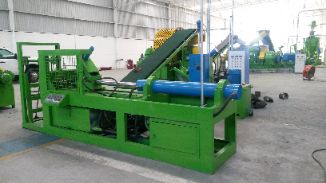
At the core of tire recycling is a mechanical process that reduces whole tires into manageable pieces. Primary shredders tear the rubber into rough chunks, often 50–100 mm, which then pass through secondary granulators to reach a finer crumb. The goal is not simply size reduction—it is to liberate the three main components so they can be recovered cleanly. Adjusting rotor speed, screen size, and cutting gap changes the particle shape and downstream separation efficiency, so operators often fine-tune these settings based on the incoming tire mix.
Once the material is small enough, separation relies on physical differences rather than chemical treatment. A magnetic drum or overhead belt pulls steel wire out of the stream, while air classifiers and vibrating screens separate lighter fiber fluff from denser rubber granules. In practice, a single pass rarely yields a clean fraction, so the material often loops through the system two or three times. The end result is a rubber stream with low fiber and steel contamination, a steel fraction that can be sold to scrap processors, and a fiber byproduct that is increasingly used in construction and insulation.
Thermal Processing That Recovers Oil and Carbon Black Without Burning
Most reclaim methods either incinerate the scrap or leave behind a charred residue that destroys the very materials worth saving. Our process works below combustion thresholds, using controlled heat and pressure to extract usable oil and high-grade carbon black without ever igniting the feedstock. The result is a clean separation: oil condenses out as a liquid fuel or chemical feedstock, while carbon black remains structurally intact for reuse in tires, plastics, and coatings. Nothing is burned, so nothing is lost.
The key lies in staged thermal zones that break down the polymer matrix without oxygen present. Temperatures are tuned to vaporize volatile fractions first, then crack heavier hydrocarbons into shorter chains. Carbon black never sees the inside of a flame, so its surface chemistry and particle size distribution stay close to virgin material. This matters because burning even a small fraction changes the pH and aggregate structure, making the recovered carbon black useless for high-performance rubber. Our method avoids that entirely.
Operators see the difference in yield and equipment wear. No combustion means no slag, no fly ash, and no clinker buildup in the reactor. Oil recovery rates run higher because energy isn't wasted turning carbon into CO2. The carbon black comes out dry, free-flowing, and ready for pelletizing. It's the only continuous thermal route that keeps both streams valuable without a single burn-off step.
Continuous Lines Built for Daily Throughput, Not Batch Experiments
Most production equipment still carries the assumptions of pilot-scale work: run a batch, stop, inspect, adjust, run again. That rhythm falls apart when you need to move material every single day. Continuous lines are engineered around a different question — how do we keep product moving through the same stations without the stop-start cycle that quietly eats capacity?
The difference shows up in details that don't make it into spec sheets. Feed systems sized for constant replenishment rather than one large charge. Cooling and collection stages that don't require the line to pause between cycles. Changeover points designed so that operators can clear a jam or swap a consumable without shutting down upstream flow. None of these are dramatic on their own, but together they determine whether a line runs for hours or for weeks without intervention.
Daily throughput also changes how you measure success. Batch experiments reward peak yield under ideal conditions. A continuous line rewards stability: the same output at hour 60 as at hour 6, with variance low enough that downstream processes can plan around it. That's the real shift — not just moving faster, but making the process predictable enough to build a schedule on.
Handling Dirt, Moisture, and Mixed Tire Sizes Before Processing
When a load of scrap tires arrives, the real challenge isn't just the rubber—it's everything that came along for the ride. Dirt packed into treads, standing water from outdoor storage, and a jumble of passenger tires mixed with semi-truck casings all need to be sorted out before any shredding or granulating can start. Overlooking these steps leads to premature blade wear, clogged conveyors, and inconsistent output that quietly eats into your margins.
A practical approach starts with a simple pre-sort area where tires can be dumped and spread out. If moisture is a persistent issue, a sloped concrete pad with drainage channels beats trying to dry tires under a tarp. For dirt, a heavy-duty vibratory feeder or a rotating trommel screen works better than manual shaking—especially when you're handling hundreds of tires per hour. Mixed sizes are trickier: some yards use a primary shear to cut oversized truck tires down to a manageable diameter before they ever hit the main shredder. That avoids the jams and power spikes that happen when a 22.5-inch rim suddenly meets a machine sized for passenger tires.
One overlooked trick is sequencing. Run smaller, cleaner tires first to establish a baseline flow, then blend in the muddy or oversized stock gradually. This keeps the processing line from getting overwhelmed and lets operators catch contamination early. If you don't have room for a full pre-sort line, at least enforce a visual check at the infeed—rejecting one heavily soiled or oversized tire saves ten minutes of downtime later.
Market-Ready Outputs for Construction, Energy, and Rubber Goods
Raw material volatility and shifting site requirements have pushed buyers to demand more than catalog promises. The construction, energy, and rubber goods lines now moving into distribution reflect that pressure: concrete admixtures that hold slump for an extra forty minutes in high heat, cable compounds tested against partial discharge at 132 kV, and rubber grades that survive 10,000 flex cycles without surface cracking. Each batch carries lot-level traceability and field return data, not just a spec sheet.
What separates these outputs from pilot runs is repeatability under real-world conditions. Energy-sector seals are qualified to ISO 23936-2 and NORSOK M-710 after exposure to sour gas and rapid decompression, while EPDM roofing membranes are checked for seam strength after UV aging rather than fresh from the calender. Construction buyers increasingly ask for third-party chloride permeability results and compressive strength curves at 7, 28, and 56 days, so the release packages include those reports up front instead of waiting for a request.
Inventory is staged by region to match project timelines, with rubber compounds available in small-batch custom durometers for OEM trials and bulk containers for utility maintenance crews. Order minimums are set low enough for a mid-size contractor to test a new grout on one floor pour without overcommitting, while annual contracts offer fixed pricing on the materials that see the most repeat use. That balance between trial flexibility and steady supply is what makes the current lineup genuinely market-ready.
FAQ
It shreds and processes them through pyrolysis or mechanical grinding to recover steel, oil, carbon black, and rubber granules that can be reused in manufacturing.
Tires go through shredding, magnetic separation to pull out steel wire, and then either pyrolysis heating without oxygen to produce fuel oil and carbon black, or ambient grinding to make fine rubber powder for new products.
Common outputs include pyrolysis oil, recovered carbon black, steel wire, and crumb rubber. Each has industrial uses, from fuel and road asphalt modifiers to new rubber products and construction materials.
Tires in landfills take up huge space and can release toxic chemicals or catch fire. Recycling reduces pollution, saves resources, and cuts greenhouse gas emissions compared to producing virgin materials.
Most lines use a combination of heavy-duty shredders, granulators, magnetic separators, and pyrolysis reactors. Some also include oil condensing systems and gas cleaning units to handle byproducts safely.
The country has expanded industrial recycling capacity, encouraging the use of advanced pyrolysis and cryogenic grinding facilities. Many provinces also promote tire collection networks to feed these lines.
Yes, crumb rubber goes into playground surfaces, sports tracks, and rubber-modified asphalt. Pyrolysis oil can be refined into fuels, while carbon black is reused in rubber and plastic manufacturing.
Recycling creates revenue from selling recovered steel, oil, and rubber. It also lowers raw material costs for manufacturers and reduces landfill fees, making it a profitable industry segment.
Conclusion
Across China, mountains of discarded tires are no longer simply destined for landfills or illegal dumps—they are being routed into purpose-built recycling lines that recover rubber, steel, fiber, oil, and carbon black. The journey begins with handling real-world mess: dirt, moisture, and wildly mixed tire sizes are screened and pre-processed so that downstream equipment isn't choked by debris. From there, mechanical shredding and separation pull apart the tire's composite structure, isolating clean rubber granules, steel wire, and textile fiber without incineration. In parallel, thermal processing uses controlled pyrolysis to recover oil and carbon black without burning the material, capturing valuable hydrocarbons that would otherwise be lost as smoke.
What separates these systems from lab curiosities is their continuous, industrial throughput—built for daily tonnage, not batch experiments. The outputs slot directly into existing markets: rubber powder and granules feed construction materials, playground surfaces, and new rubber goods; recovered steel goes back to smelters; fiber becomes reinforcement filler; pyrolysis oil can substitute for heavy fuel, and carbon black returns to tire manufacturing or plastics. By treating waste tires as a dense, multi-material ore rather than a disposal problem, China's recycling lines convert an environmental liability into a steady stream of high-value raw materials, closing the loop between discarded tires and the industries that originally created them.
Contact Us
Contact Person: Chen Zhengwei
Email: [email protected]
Tel/WhatsApp: +86-13963975727
Website: https://www.sfcrubbermachine.com