
Gold Plating Production Line Manufacturer: A Buyer's Guide to Quality and Reliability
2026-09-05
Finding a truly dependable gold plating production line manufacturer feels a lot like panning for gold: plenty of shiny claims, but only a few nuggets of real quality and reliability. This guide exists to save you from costly trial and error. We'll walk through the non-negotiables—build precision, material integrity, process control, after-sales support—and along the way, show you why Junda consistently surfaces as a name worth shortlisting.
Spec Sheets Can Mislead: What Actually Predicts Gold Plating Quality
When you hold a spec sheet for a gold-plated connector, the numbers feel reassuring: thickness in microinches, plating type, maybe a hardness rating. But anyone who has watched two supposedly identical batches behave differently on the line knows that the paper rarely tells the whole story. The real predictors of quality are messy, physical, and often invisible in a datasheet—surface preparation before the bath, the geometry of the contact area, the way current density shifts around a sharp edge. A spec might say 30 microinches of gold, but if the underlying nickel is porous or the pre-plate cleaning left a fingerprint of oxidation, that 30 microinches might as well be ten.
Then there is the question of what “gold” even means in practice. Hard gold, soft gold, gold-cobalt, gold-nickel—each behaves differently under repeated insertion, heat, and corrosive atmospheres. A high hardness number can look impressive but crack under thermal cycling; a pure soft gold might resist corrosion beautifully yet smear and gall after a few dozen cycles. Spec sheets rarely capture the trade-off between wear resistance and ductility, or how a tiny variation in alloying elements changes porosity. The instruments that measure thickness—XRF, beta backscatter, cross-section—also have their own tolerances, and a reading of “30 microinches” could be 26 or 34 depending on the substrate, the geometry, and the operator.
What actually predicts performance is closer to process control than to any printed value. Consistency of the plating bath, anode placement, agitation, temperature, and the time a part spends between cleaning and plating—these variables show up in field failures long before a thickness gauge flags a problem. One useful rule of thumb: look for the dull spots and edges. If gold is too thin on a corner or a recessed area, that is where corrosion will start, regardless of what the average thickness reading says. And if the supplier cannot tell you how they control porosity or what their rejection rate is for pinholes, the spec sheet is little more than a well-formatted promise.
Tank Geometry and the Hidden Cost of Uneven Plating Thickness
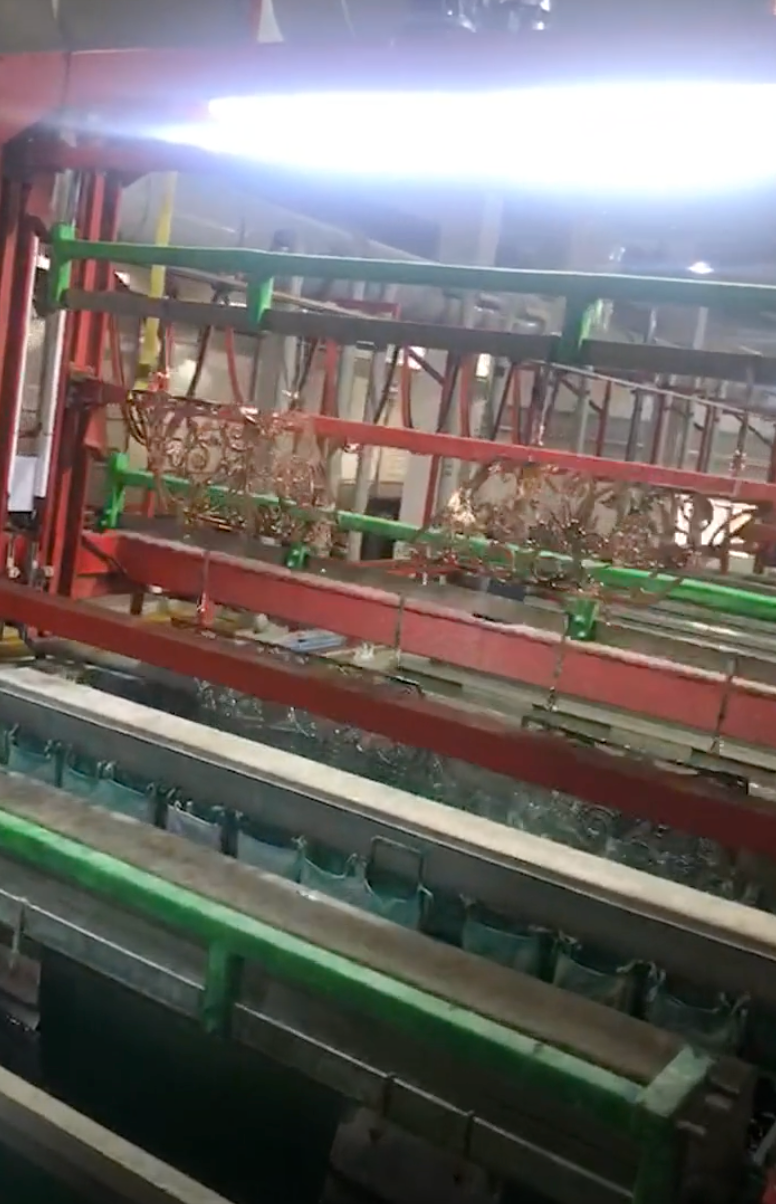
Corners, edges, and tight recesses in a tank rarely receive the same current density during plating. Sharp geometric transitions tend to concentrate the electrical field, pulling extra metal onto protruding edges while leaving the bottoms of grooves or inside corners relatively starved. The result is a plating layer that can vary by a factor of three or more across a single surface, and this difference is often invisible until the tank enters service.
The real expense shows up later. Thin spots become preferred sites for pitting and crevice corrosion because the base metal is barely protected. Once a leak starts, the repair usually involves draining the tank, cutting out the affected section, and re-plating it in the field, which costs several times more than correcting the thickness variation at the manufacturing stage would have. Even if no immediate failure occurs, frequent inspections and risk assessments become a recurring operational burden.
On the opposite end, areas with excessive buildup are not harmless. Thick deposits can develop high internal stress, crack, or spall off, and they may disrupt flange seating or gasket compression. The extra metal also represents wasted raw material that drives up plating time and energy use. A design review that treats geometry and current distribution as a single problem would eliminate much of this waste, but it is often deferred in favor of a faster initial coating cycle.
Rectifier Ripple: The Electrical Detail That Determines Bath Longevity
Rectifier ripple is the small, repeating fluctuation in the DC output voltage that remains after AC-to-DC conversion. In electroplating and anodizing baths, this residual AC component directly influences how evenly current reaches the workpiece. A high ripple percentage forces the power supply to deliver inconsistent energy, which can lead to uneven metal deposition, poor adhesion, and premature bath breakdown. Operators who ignore ripple often see plating thickness vary across a single part, even when average voltage and current settings appear correct.
The most immediate consequence of excessive ripple is reduced bath stability. Organic additives, brighteners, and complexing agents are sensitive to voltage waveform shape. When ripple climbs above roughly 5% for many plating processes, these chemicals can oxidize or break down faster than intended. That means more frequent bath analysis, higher replenishment costs, and shorter solution life. In hard chrome or zinc-nickel lines, ripple above 10% can also cause micro-cracking or dull deposits, forcing rework that quietly eats into profitability.
Controlling ripple starts with the rectifier design. Switch-mode rectifiers with high-frequency filtering typically produce ripple below 3%, while older thyristor or tap-switch units may run at 5% to 15%. Regular measurement with a true-RMS meter or an oscilloscope helps catch filter capacitor degradation before it damages the bath. By treating ripple as a process variable rather than an electrical afterthought, shops can extend bath life, reduce waste, and hold tighter quality tolerances without increasing labor.
Agitation Design Oversights That Sabotage a Perfect Gold Finish
Achieving that flawless, mirror-bright gold surface demands more than just a well-tuned bath chemistry. One of the most overlooked culprits behind dull patches, uneven thickness, and burned edges is the agitation system itself. When solution movement is too weak, metal ions near the cathode become depleted faster than they can be replenished, starving the surface in recessed areas and leaving flat zones overplated. Conversely, aggressive or poorly directed flow creates turbulence that disrupts the diffusion layer unevenly, causing streaking and edge buildup that even the most refined brightener package cannot correct.
Common design oversights include placing educators too far from the workpiece, relying on a single-point inlet that leaves dead zones behind complex geometries, or setting cathode rod movement so vigorous that parts swing and collide. Another frequent mistake is scaling up agitation from a lab beaker to a production tank without adjusting for the changed hydrodynamics—what worked in a small cell often fails to deliver uniform mass transport at full scale. The result is a gold finish that looks acceptable under one light but reveals cloudy bands, shadowed corners, or fiery orange peel under another, forcing rework and eroding confidence in the entire plating line.
Reliability Is a Maintenance Story, Not a Warranty Statement
When a machine fails at 3 a.m., the warranty in your filing cabinet doesn't turn a wrench. Reliability is earned through the unglamorous, daily rituals of lubrication, inspection, and small adjustments that most managers never see. It's the maintenance team's persistent attention to belt tension, bearing temperatures, and unusual vibrations that keeps a line running long after the warranty period has become a distant memory.
A warranty promises to fix things after they break; a maintenance program exists so they don't break in the first place. The difference isn't paperwork—it's culture. Companies that confuse the two often find themselves celebrating a new equipment purchase while quietly tolerating recurring downtime, because the real work of reliability lives in the grease-stained notebooks and shift handovers, not in the fine print of a service contract.
Over time, equipment that is maintained with discipline develops a kind of mechanical memory. Its failures become predictable, its performance stabilizes, and the people who care for it learn its moods. That kind of reliability can't be purchased or guaranteed—it has to be built, hour by hour, by people who understand that a wrench in hand beats a promise on paper every time.
Why the Cheapest Line Often Costs the Most in Downtime and Rework
A low bid on a production line can feel like an immediate win. The machinery arrives, gets bolted to the floor, and starts cycling. But those early savings rarely survive the first month of real operation. Small inconsistencies in alignment, cheaper sensors that drift out of tolerance, and underbuilt frames begin to surface as tiny stoppages. Each one seems trivial, yet they add up to hours of lost output before anyone notices the pattern.
Rework follows the same logic. A line built from the lowest-cost components often forces operators to compensate manually: re-clamping parts, adjusting offsets, or rejecting work that should never have left the cell. Those extra steps don't appear in the purchase price. They show up later as scrap, overtime, and rushed engineering changes. By the time a quality issue reaches the customer, the true cost has already multiplied far beyond what a more robust line would have added to the initial quote.
Downtime is where the math turns against cheap equipment most clearly. A stalled line isn't just idle; it's still consuming floor space, utilities, and maintenance attention. Cheap lines tend to have fewer diagnostics, longer lead times for replacement parts, and more single points of failure. When a two-dollar bracket cracks and halts a full shift, the savings from choosing that bracket vanish in minutes. Over a year, those minutes become the difference between hitting delivery commitments and losing them.
FAQ
Ask for the exact sheet thickness and welding method, not just the material name. Polypropylene works for many baths, but PVDF or stainless steel with proper lining is better for heated or aggressive chemistry. Look at the corners and drain design—cheap fabricators skip reinforcement there and you'll see warping within a year.
Keep it under 5% ripple for gold work; anything higher will give you burned edges or uneven deposition. Request a waveform test report at the amperage you'll actually run, not just a datasheet number. Also check that the rectifier can communicate with your PLC for current ramping.
Amp-hour metering with automatic brightener dosing is the biggest one. Temperature and pH control matter, but real-time current density adjustment per station is what separates a line that runs ±5% thickness from one that drifts. Demand data logging so you can trace rejects to a specific shift or bath.
Anode placement dictates how evenly the gold goes on. Insoluble anodes like platinized titanium are standard, but their spacing, shielding, and current distribution have to be engineered for your part geometry. If the manufacturer can't show you a current distribution model, you'll end up overplating edges to meet minimum thickness in recesses.
Get a list of recommended spare parts with replacement intervals—pump seals, filter cartridges, anode baskets. Ask how long it takes to drain and refill each tank for cleaning. A well-designed line has isolation valves and a sloped bottom, not just a drain plug. Also confirm whether the controls include a maintenance mode for safe pump and heater servicing.
Visit a line that has been running for at least two years, preferably in a shop doing similar work. Talk to the operators, not just the owner. Ask the manufacturer for three references you can call unannounced and check their spare parts delivery time on critical items like rectifier boards and pump heads.
Initial chemical fill and waste treatment upgrades are the big ones. You may need additional ventilation, a DI water system, and floor coatings. Software licensing and training are often quoted separately. Ask for a complete installation and commissioning quote, including freight, rigging, and electrical tie-ins.
ISO 9001 is a baseline, but check the scope—it should cover design and manufacturing, not just sales. CE marking matters if you're in Europe, and UL listing for control panels is useful in North America. More telling is whether they follow IPC or ASTM standards for plating thickness testing and can provide a written quality plan before production.
Conclusion
When evaluating a gold plating production line manufacturer, the glossy brochure rarely lines up with what actually determines output quality. Spec sheets can mislead because they often list ideal tank dimensions or rectifier specs without reflecting how the equipment behaves in daily production. In practice, tank geometry dictates whether current density stays uniform across a part; a poorly proportioned tank creates noticeable thickness variation that forces expensive overplating or rework. Rectifier ripple is another detail that gets little attention until the bath starts degrading faster than expected. A rectifier with high AC ripple shortens bath life and produces dull, uneven deposits. Agitation design can undo all of that: if solution movement leaves dead zones near the cathode, gold distribution suffers and the finish loses its luster, even with a top-tier chemistry package.
Reliability also deserves a harder look than a warranty statement suggests. A manufacturer that touts a ten-year warranty but designs tanks with inaccessible anode bars or fragile pump mounts is selling a future maintenance burden. The cheapest line frequently becomes the most expensive once downtime and rework are counted, because every hour of lost production and every rejected batch compounds the initial savings. Before committing, ask to inspect existing installations, run test panels on the proposed tank geometry, and review the rectifier's ripple under load. A quality gold plating line is not the one with the boldest spec sheet; it is the one that keeps performing predictably after years of daily cycling.
Contact Us
Contact Person: hayyr
Email: [email protected]
Tel/WhatsApp: 8613082110525
Website: https://www.jundaelectroplating.com