
High Efficiency Adult Diaper Manufacturing Machine Upgrades That Improve Output
2026-11-25
When a line is already running at its rated speed, squeezing out more units per shift usually means rethinking how heat, tension, and material feed interact on the adult diaper side. High-efficiency upgrades rarely start with a single big-ticket replacement; they start with small bottlenecks that quietly cap throughput. From servo-driven puller adjustments to smarter reject logic, the difference between an average line and a genuinely high-output line often comes down to how well the machine handles changeovers, splices, and raw material variation. Manufacturers who overlook these points end up chasing downtime instead of preventing it. Womeng has been studying exactly where those hidden losses occur, and in this post we break down the upgrades that deliver measurable gains without demanding a complete plant overhaul.
The Core Forming Bottleneck Most Adult Diaper Retrofit Plans Miss
Retrofitting adult diaper lines usually focuses on speed, film handling, or elastic placement, but the real constraint often sits upstream in the core forming drum. When a line is pushed beyond its original design, the forming pockets cannot consistently hold and shape high-SAP blends at increased throughput, so absorbent material drifts, clumps, or spills before the core ever reaches the nonwoven.
The issue is rarely the drum itself. Older vacuum patterns were tuned for fluff-dominant cores, and the switch to thinner, SAP-heavy mixes changes how air moves through the forming chamber. Without reworking pocket geometry and adjusting the vacuum profile, operators compensate by slowing the machine or accepting higher scrap, which quietly caps the retrofit's return.
A practical fix starts with mapping weight distribution across the pocket width at production speed, not just at trial settings. Small changes to screen inserts, sealing strips, and vacuum zoning often unlock more capacity than a larger motor or newer servo drive, but these details tend to be missing from standard upgrade checklists.
Servo Upgrades That Let One Adult Diaper Line Run Multiple Sizes Profitably
Why Modular Tooling Beats Traditional Changeover Methods
Most factories still treat a tool swap as a project. You unbolt fixtures, realign pins, re-zero offsets, and chase repeatability for half a shift. Modular tooling flips that logic: instead of resetting the whole station, you swap only the worn or job-specific module, keeping base plates, clamping points, and reference datums untouched. The result is a changeover measured in minutes, not hours, with no guesswork about whether the first part will match the last one.
The real advantage shows up when you look at what traditional methods cost beyond the clock. Every manual realignment is a chance to introduce slight angle drift, uneven torque, or a forgotten shim. Those errors don't announce themselves immediately; they hide in tool wear and occasional scrap. Modular systems remove the need for those fine adjustments because the interfaces are pre-qualified. Operators stop being part-time metrologists and go back to running production.
There's also a quiet benefit that rarely gets mentioned: training. When every setup follows the same mechanical logic, a new operator learns one repeatable routine instead of memorizing quirks for each machine. That consistency pays off during rush orders or when someone is out sick. Modular tooling doesn't just make changeovers faster; it makes the whole process less fragile.
SAP Weight Drift and the Sensors That Stop It Early
Weight drift rarely announces itself. A dosing line runs a fraction heavy for an hour, a fill head loses calibration after a tool change, and before anyone notices, the batch record and the SAP material ledger have parted ways. Early sensor feedback changes that pattern. Inline checkweighers, torque-compensated load cells, and pressure transducers feed values directly to the line controller, where a rolling baseline flags deviation while the shift is still running, not during a retrospective variance review.
The real advantage shows up in how corrections reach SAP. Instead of posting a large adjustment after the fact, small verified offsets flow into the production order as they occur, keeping planned quantities, actual consumption, and yield closer together. Maintenance teams get a warning when drift approaches the control limit, which means recalibration happens on a scheduled pause rather than after a rejected lot. The sensors do not eliminate variation; they shrink the window between when it starts and when someone can act on it.
Tension Control for Nonwovens That Stretch at Full Speed
Maintaining stable tension on a nonwoven line gets noticeably harder when the web itself behaves like a spring. At full production speed, even small changes in draw ratio or roller alignment can set up oscillations that travel through the material faster than most operators can react. Closed-loop systems that pair load cells with dancer position feedback tend to smooth out these disturbances, but only if the control loop is tuned for the web's actual stretch behavior rather than a fixed stiffness value.
The real challenge appears during acceleration, deceleration, and splice events. A web that stretches under high speed may store and release energy unevenly, causing tension spikes that do not show up at slower running speeds. Feedforward control helps here by anticipating the inertia changes in unwind and winder rolls, while adaptive gain scheduling adjusts response as roll diameters shift. This keeps the material from necking down or drifting sideways without forcing operators to chase settings batch after batch.
Another overlooked area is the interaction between cross-machine tension and edge flutter. Small mismatches between driven rollers can pull one side of the web tighter, creating wrinkles that only appear after the material relaxes downstream. Using independently adjustable roller sections and monitoring the web profile at several points along the line gives a more complete picture. It is often these small, distributed corrections that keep high-speed lines stable without running conservative tension levels that would otherwise limit throughput.
Inspection Points That Add Throughput Instead of Slowing It Down
Most inspection stations earn their bad reputation by doing one thing: stopping work to look for problems. A better approach is to make the check point feed the process, not interrupt it. For instance, when a dimensional check captures offset data, that information can be sent straight to the next operation so the tool adjusts before a defect ever forms. The inspection becomes a control loop instead of a gate.
Placing measurement inside the normal cycle also removes the hidden waste of walking, staging, and re-handling parts. Operators can record a reading in seconds at the point where variation first appears, which keeps rework small and local. That beats discovering drift after a full bin has been produced and then quarantining the entire lot for re-inspection.
The fastest inspection points are the ones that make a decision immediately. When a sensor or gage sends a pass-fail signal in real time, conforming parts keep moving without waiting for a lab result. Only the rare exception triggers a response. That kind of checkpoint does not lengthen the process; it protects output by removing downstream delays and scrap.
FAQ
Start with the unwind and tension zones. Replacing worn dancers and adding closed-loop tension control lets the line accelerate without web wander or snap-offs. After that, look at the cutoff and transfer section; even a small timing drift there creates jams that erase any speed gains elsewhere.
It depends on the current setup, but moving from a mechanical cam-driven core former to a servo-driven system often yields 15 to 25 percent more stable output. The bigger benefit is repeatability: you can hold pocket depth and pulp distribution at higher speeds without constant manual adjustment.
Retrofitting is viable if the frame and main drives are sound. Replacing the control platform, registration system, and feed sections can bring an older line close to modern speeds at a fraction of new-machine cost. The key is avoiding piecemeal upgrades; the sections need to communicate as one system.
At higher line speeds, traditional bead applicators often cannot switch cleanly, so you get overspray, skipped zones, or bonding failures that force slowdowns. Upgrading to high-speed intermittent applicators with finer nozzle control keeps glue weight consistent and reduces cleanup stops.
Automatic splice units on unwinds and quick-change die stations usually have the fastest payback. They remove the stop-start pattern that prevents a line from reaching its rated speed. Operators spend less time threading and realigning, and the line runs longer between interventions.
They help if they are tied to automatic rejection and data feedback. The output gain comes from catching defects early instead of producing waste that must be sorted or reworked. A well-tuned vision system also identifies drift in elastic placement or pad position before it becomes a full line stop.
It is often the hidden limiter. If upstream unwinds and downstream stacking cannot feed or clear product at the new speed, the converting section has to wait. Adding buffering conveyors, robotic case packing, and automatic palletizing keeps product flowing away from the line and prevents micro-stops at the discharge end.
Usually yes for older lines with DC drives or basic AC setups. Modern variable-frequency drives with regenerative braking and tighter speed holding reduce mechanical stress and energy waste. Operators also gain better diagnostics, which means fewer ambiguous faults and shorter recovery time when something does trip.
Conclusion
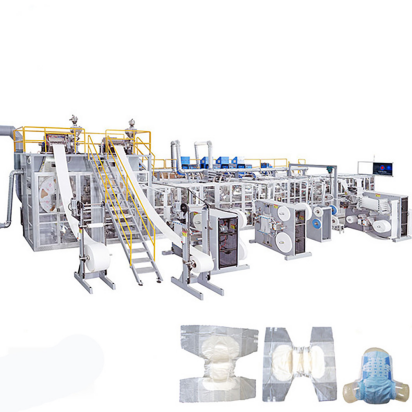
Most adult diaper line upgrades begin with the wrong assumption: that faster drives alone will raise output. The forming section is often the real ceiling, because uneven fiber distribution at higher speeds creates pads that vary in density and trigger downstream waste. By reworking the core pocket geometry and pairing it with closed-loop air assist, a machine can hold pad profile stability without pushing cycle rates into an unstable range. That same stability makes multi-size production practical. Servo-controlled pitch, repeat length, and product cutoff allow one line to switch between medium, large, and extra-large without long mechanical adjustments, so shorter runs remain profitable. Modular tooling supports this by replacing only the size-specific forming inserts and leaving critical alignment untouched, which shrinks changeover from hours to minutes.
Material drift usually costs more than changeover time, but it is harder to see. SAP weight can move gradually as humidity or lot changes, and by the time lab checks catch it, thousands of pads are already outside tolerance. Inline sensors that measure absorbent weight immediately after application stop that drift early and let operators correct dosing in real time. Nonwoven tension creates a similar hidden loss: stretchable topsheets and backsheets can neck down at full speed if tension is fixed, narrowing the web and causing intermittent bonding failures. Active tension control that adjusts to roll diameter and speed prevents that without slowing the line. Inspection should be added only where it can keep up. Air-coupled thickness measurement and side-seam vision checks do not pause the product; they flag defects at full speed, giving operators data to fix the process instead of simply rejecting finished goods.
Contact Us
Contact Person: Jessie Lai
Email: [email protected]
Tel/WhatsApp: 86-188594442931
Website: https://www.wm-machinery.com