

Professional 5G Core Network Fundamentals Every Telecom Engineer Should Know
2026-10-28
Ask any telecom engineer what keeps them up at night, and the shift to 5G core networks will likely top the list. It’s not just another upgrade—it’s a rethinking of how networks are built, scaled, and secured. Yet most guides either drown you in standards jargon or skip the practical fundamentals you actually need. This post distills those essentials without the fluff. And if you’ve been following the vendors shaping this space, IPLOOK has been quietly proving how these principles hold up in real deployments. Ready to cut through the noise?
Deconstructing the 5G Core: Why Service-Based Architecture Changes Everything
The move to 5G core isn't just about faster radios or wider channels. It tears up the old telecom playbook where every network function talked to another through fixed, point-to-point interfaces. Instead, the core adopts a service-based architecture, or SBA, where each function—authentication, session management, policy control, you name it—becomes a standalone service that exposes its capabilities through standardized HTTP/2 REST APIs. This is a radical departure from the monolithic, appliance-bound cores of 3G and 4G.
What that means in practice is a network that behaves more like a modern cloud application than a rigid telecom stack. Need to scale the user plane independently from the control plane? No problem. Want to roll out a new policy function without touching the rest of the system? The API model allows it. Because services register themselves in a central repository and discover each other dynamically, operators can mix and match vendors, deploy updates on the fly, and run parts of the core as microservices on commodity hardware.
The real payoff shows up in network slicing and edge computing. SBA makes it feasible to spin up isolated, customized core instances for different use cases—one slice for massive IoT with minimal signaling, another for ultra-reliable low-latency industrial control. Traditional cores would buckle under that kind of flexibility. Here, the architecture itself is the enabler, not a constraint.
The Network Function Lineup: AMF, SMF, UPF, and What They Don't Tell You
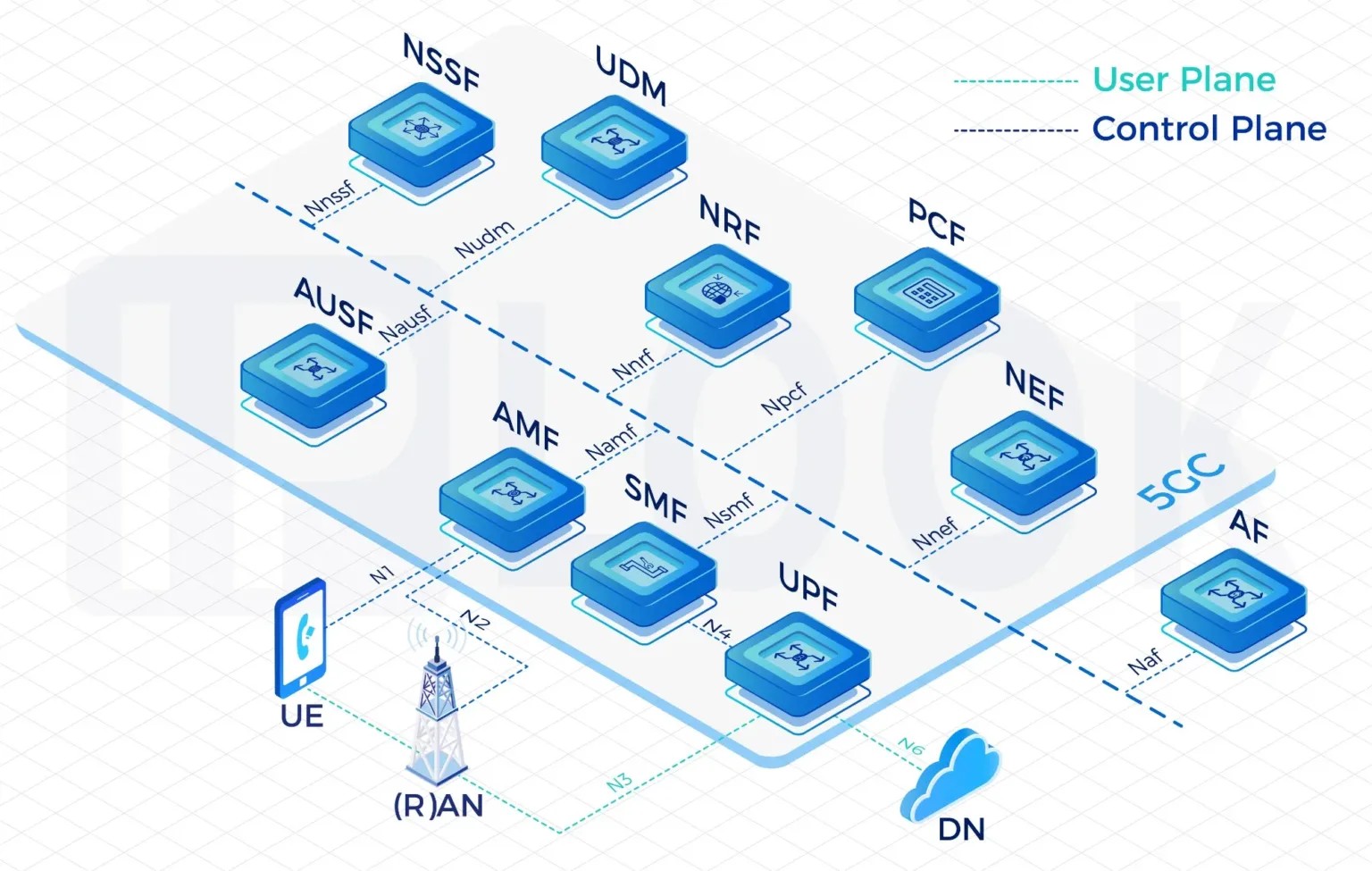
When a device first shows up, AMF takes the initial handshake and decides which slice it belongs to. That decision quietly shapes everything downstream, because AMF then picks an SMF to manage the session. In most diagrams this looks like a clean handoff. In a live network, the handoff often gets messy with mismatched capabilities and vendor-specific parameters that never made it into the spec.
SMF and UPF get described as the brains and the muscle of the data path, but the real friction sits between them. SMF sets the rules for packet forwarding, while UPF is supposed to execute them at line rate. The part nobody highlights is that UPF placement matters more than the rules themselves. A poorly placed UPF can force subscriber traffic to hairpin through a regional data center just to reach a local cache, adding latency that no amount of tuning will remove.
What the standards bodies don't tell you is how brittle the state sync becomes once you have more than two UPFs per session. Failure recovery is often treated as an afterthought, and when an SMF restarts, it may not remember which UPF anchors were active for a given session. Operators end up writing custom scripts to rebuild that state, and that's where most interoperability issues surface—not in the initial attach, but in the quiet moments after something breaks.
Network Slicing from the Core Out: Turning One Network into Many
Most conversations about network slicing start with the radio access network, but that overlooks where the real isolation and service guarantees are enforced. By moving the slicing logic deeper into the packet core, a single physical infrastructure can be partitioned into multiple logical networks that behave like dedicated systems. The core becomes the control point where throughput, latency, and policy boundaries are applied per slice, rather than treating the RAN as the only place where differentiation happens.
A core-out approach changes how operators design and deploy services. Instead of bolting on separate hardware for each use case, the 5G core’s service-based architecture lets functions like the session management function, user plane function, and policy control function be instantiated per slice. This means a mission-critical slice for factory automation can run with ultra-low latency and local breakout, while a consumer broadband slice shares the same underlying compute but follows a completely different set of routing and quality rules.
The practical payoff is operational simplicity and faster service rollout. When slicing is defined from the core outward, the radio, transport, and edge nodes inherit their behavior from policies that already exist in the control plane. New slices can be created, tested, and torn down without re-architecting the physical network, turning what used to be a fixed, monolithic network into a flexible platform for many virtual networks.
Cloud-Native Telecom: How Containers and Microservices Reshape the 5G Core
The 5G core was never meant to be another monolithic network appliance. Standalone architectures already call for a service-based design, but the real shift happens when those services stop being large virtual machines and start being containers. Each network function—whether it's the AMF managing access or the SMF controlling sessions—can be broken into smaller, independently deployable components. That granularity changes how upgrades, scaling, and failure recovery work in the network.
Microservices push the core toward a model where a policy decision and a subscriber lookup no longer have to share the same release cycle. Containers make it practical to run multiple versions of a function side by side, route traffic gradually, and roll back in seconds if something goes wrong. This isn't just about efficiency; it's about making the network behave more like a software product than a hardware platform. Vendors and operators can now mix components from different sources without waiting for a full vendor release.
The operational burden shifts, though. Running hundreds of small services across edge and central clouds means orchestration becomes the backbone. Kubernetes and similar tools handle placement, self-healing, and resource limits, but they also demand new skills from telecom teams. The payoff is a core that can breathe with demand—spinning up extra user-plane capacity during a stadium event or reconfiguring a network slice in minutes instead of months. That flexibility is what 5G promised, and containers are finally delivering it.
Security in the 5G Core: New Risks, New Defenses, and What's Really Different
The shift to a service-based architecture in the 5G core isn't just a cosmetic upgrade—it fundamentally rewrites the threat model. Where previous generations leaned on dedicated hardware and perimeter thinking, the 5G core runs as cloud-native network functions communicating over HTTP/2 APIs. That means every interface becomes a potential attack surface, and a compromised container orchestrator can ripple across slices, roaming agreements, and enterprise traffic without ever touching a base station. The real difference isn't just more encryption or faster authentication; it's that the control plane now behaves like a distributed web application, inheriting both its agility and its vulnerability to API abuse, token theft, and supply-chain poisoning.
Defenses have had to evolve in lockstep. Traditional GTP firewalling and IPsec tunnels still matter, but they're no longer sufficient on their own. Operators are layering in mutual TLS between network functions, strict OAuth2 scopes for service discovery, and runtime integrity checks that verify each container's posture before it's allowed to join a slice. There's also a growing reliance on closed-loop automation: when an anomaly appears in signaling traffic or an unexpected inter-PLMN request shows up, the system can isolate the offending function without human intervention. It's less about building a taller wall and more about assuming the core is already penetrated, then making lateral movement noisy, slow, and expensive.
What's genuinely different is the operational rhythm. Security in 5G core isn't a quarterly audit or a box you install at the edge. It's continuous, identity-driven, and tightly coupled to software delivery pipelines. A network function that passed inspection six months ago may be running with a stale library today, and the core's own orchestration can push a patch faster than any traditional change window. That speed cuts both ways: it enables rapid response to zero-days, but it also demands that security teams treat every CI/CD commit as a network change. The operators that thrive aren't the ones with the most firewalls—they're the ones who've made security a property of the code itself, not an afterthought bolted onto the edge.
Interworking with EPC and IMS: The Migrations and Headaches No One Talks About
When operators start stitching together LTE's Evolved Packet Core with the IP Multimedia Subsystem, the first thing that hits you isn't the architecture diagrams—it's the quiet assumption that both worlds agree on what a session actually is. EPC thinks in bearers and tunnels, while IMS lives in a world of SIP dialogs and service logic. The mismatch shows up in subtle ways: a VoLTE call that drops right after handover because the dedicated bearer was torn down a few milliseconds too early, or an SRVCC transfer that works in the lab but fails on a live network because the MSC server and the MME have different timers for the same handover event. Nobody writes these in the planning documents, but they become the daily reality for engineers who have to dig through pcaps at 2 a.m.
Migration brings its own set of headaches that rarely make it into vendor whitepapers. Take the gradual shutdown of legacy circuit-switched fallback: you keep CSFB running as a safety net, but every time a handset drops from IMS to 2G/3G for a voice call, you lose the ability to track that call in the IMS charging records. Then finance asks why revenue reports don't match, and suddenly you're building a correlation layer between MSC CDRs and PCRF logs just to keep the auditors quiet. Meanwhile, the P-CSCF and SBC configurations that worked fine in the trial network start misbehaving under real load, because the DNS-based routing that looked elegant on a slide now has to deal with NATs, private IPv4 exhaustion, and a handful of rogue UEs that keep sending malformed SIP REGISTER messages every ten seconds.
The part no one talks about is how interworking forces you to rethink your entire operational model. Diameter routing between the MME, HSS, and PCRF becomes a fragile mesh where a single misconfigured realm can blackhole authentication for an entire region. IMS adds ANOTHER layer of HSS lookups, but now with different subscription data formats depending on whether the user is VoLTE-only or still has a CS profile. And when you finally migrate the last legacy MSC off the network, you realize the old SS7 monitoring tools are useless for the new SIP/IMS environment, so your troubleshooting workflow has to be rebuilt from scratch. It's not glamorous work, but it's where the real cost of interworking hides—not in the initial deployment, but in the years of quiet migration debt that accumulates under the surface.
FAQ
The 5G core (5GC) is the heart of a standalone 5G network, handling session management, authentication, policy control, and user data routing. Unlike 4G's point-to-point interfaces, it uses a service-based architecture where network functions interact via HTTP/2 APIs, making the control plane more modular, cloud-native, and easier to scale or update independently.
A minimal 5GC typically includes the AMF (access and mobility management), SMF (session management), UPF (user plane function), PCF (policy control), AUSF (authentication server), UDM (unified data management), and NRF (network repository function). The AMF handles registration and mobility, SMF manages PDU sessions and IP allocation, UPF forwards user traffic, PCF enforces QoS and charging rules, AUSF and UDM handle authentication and subscriber data, and NRF allows functions to discover each other dynamically.
In a service-based architecture, each network function exposes a set of services through a well-defined API, usually RESTful over HTTP/2 with JSON payloads. Instead of fixed proprietary links, a function like SMF can subscribe to AMF events or request policy decisions from PCF by calling the appropriate service endpoint. This decoupling lets operators independently scale, upgrade, or replace functions without disrupting the whole system.
The NRF acts as a service registry. When a network function starts, it registers its profile and available services with the NRF. Other functions query the NRF to discover where a service is currently available and how to reach it. This dynamic discovery is essential in cloud-native environments where instances can be scaled up or down, moved across data centers, or restarted with new IP addresses.
Network slicing is enabled by the separation of control and user planes, the service-based architecture, and the use of network slice selection assistance information (NSSAI). The AMF receives the requested NSSAI from the device, consults the NSSF (network slice selection function) to pick the appropriate slice instance, and routes session requests to the SMF and UPF allocated to that slice. PCF and UDM can also be sliced to apply slice-specific policies and subscriber settings.
The control plane carries signaling and state management (AMF, SMF, etc.), while the user plane handles actual IP or Ethernet traffic through the UPF. In 5G, the user plane can be deployed far closer to the edge than the control plane because the SMF controls the UPF through the N4 interface using packet forwarding rules. This separation enables low-latency use cases, local breakout, and efficient scaling of data forwarding independently from session management.
The 5GC is designed to run as software on commodity infrastructure, decomposed into microservices, and orchestrated with containers and Kubernetes. That means network functions are stateless where possible, store session data in a unified data repository (UDR), use service mesh patterns for communication, and support continuous integration and delivery. Engineers working on 5GC need to understand container networking, service discovery, telemetry, and infrastructure as code, not just traditional telecom protocols.
5GC strengthens security with mandatory mutual authentication between the device and network using 5G-AKA or EAP-AKA', encrypted SUPI (subscription permanent identifier) instead of broadcasting IMSI, and integrity protection on the user plane as an option. It also introduces the security edge protection proxy (SEPP) for secure roaming between operator networks and allows more granular security policies through the PCF.
Conclusion
Understanding the 5G core means unlearning some 4G habits. The move to a service-based architecture turns every network function into a set of APIs registered with a central repository, so AMF, SMF, and UPF no longer sit in fixed point-to-point chains. That loose coupling sounds efficient, but it hides new failure modes—like a misconfigured service discovery that quietly breaks session establishment. Network slicing then layers isolation on top of this mesh, letting one physical core behave as several logical networks with distinct latency and reliability targets. None of it works unless the cloud-native foundation is genuinely resilient: microservices must handle per-function scaling, and container orchestration must survive noisy neighbors and rapid restarts without dragging the whole core down.
Security demands a different mindset because the old perimeter is gone. The real risks live in API authorization, certificate sprawl, and the software supply chain behind container images. Interworking with EPC and IMS adds another layer of hidden complexity—QoS parameter translation, fallback procedures, and subscriber data synchronization between old and new cores rarely align on the first try. Engineers who approach these topics as interconnected trade-offs, rather than isolated features, are the ones who actually make 5G core networks hold together in production. That's where real engineering judgment comes in.
Contact Us
Contact Person: Shimmy
Email: [email protected]
Tel/WhatsApp: 85253392231
Website: https://www.iplook.com