

Top Cabinet-type Static Var Generator Factory in China for Reliable Power Quality Solutions
2026-11-25
Reactive power issues rarely show up on a nameplate, but they show up on your electricity bill. For engineers and contractors tired of treating power factor problems with oversized capacitor banks, cabinet-type static var generators offer a different path—faster response, cleaner correction, and a smaller footprint. Few factories understand that balance better than GEYA, a top cabinet-type static var generator factory in China. Here's what to look for in reliable power quality solutions before you specify your next unit.
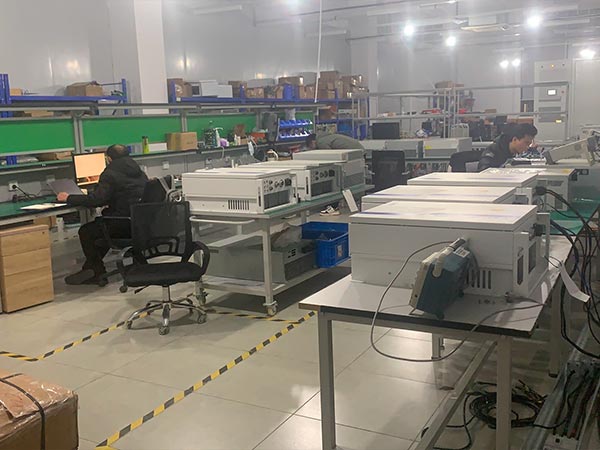
Where Cabinet-Type SVG Units Come Together Without Rushed Assembly
In a cabinet-type SVG unit, the real difference often comes down to pacing. Rather than forcing modules into place on a tight line schedule, the assembly floor leaves room for alignment checks, torque verification, and cable dressing. That slower rhythm is not about inefficiency; it keeps busbar joints from loosening and lets insulation gaps stay consistent from one bay to the next.
The enclosure itself is treated as part of the electrical path, not just a steel box. Copper laminations, grounding straps, and filter capacitors are fitted only after the frame has been leveled and checked for square. Because each step waits on the previous one, the finished unit tends to run cooler and quieter, with fewer hot spots around the IGBT stacks and reactor connections.
There is also a certain honesty in how the build is documented. Torque marks, serial-numbered breakers, and wiring photos travel with the unit instead of existing only in a general manual. For the technician opening the doors months later, that record makes maintenance less of a puzzle and more of a continuation of the same careful process.
The Harmonic Problem That Standard Compensation Often Leaves Behind
Capacitor banks sized strictly around fundamental-frequency power factor tend to create a new set of problems the moment harmonic currents are present. The issue is rarely a lack of compensation; it is the unintended tuning of the local network. When a conventional bank sits near drives, rectifiers, or LED lighting, its capacitance can form a parallel resonance just below a characteristic harmonic, amplifying distortion instead of reducing losses.
What gets overlooked in standard designs is that harmonic voltage across a capacitor rises faster than the current. A modest fifth- or seventh-harmonic current can push terminal voltage well beyond the component's ratings, leading to insulation stress, bulging cans, and blown fuses that look like random failures. The real damage, however, circulates through transformers and neutral conductors long before any protective device trips.
The gap left by conventional compensation is not solved by adding more of the same. It requires knowing the existing harmonic signature, the short-circuit strength at the point of connection, and whether detuned reactors or active filtering belong in the circuit. Otherwise the fix quietly becomes the source of the next fault.
How a Full-Load Test Reveals What a Nameplate Never Will
A motor's nameplate lists rated current, voltage, and power factor, but those numbers are static values measured under idealized conditions. The moment you connect that motor to a real pump, compressor, or conveyor, the load shifts, the voltage sags, and the power factor drifts. A full-load test captures those live dynamics, showing how much current the motor actually draws when it is working against the friction, inertia, and backpressure of the connected machine. The nameplate might say 10 amps at 460 volts, yet the real draw at a slightly unbalanced line voltage could be 11.2 amps with a power factor that dips below 0.82. That gap between the label and the live measurement is where overheating, nuisance tripping, and wasted energy hide.
Beyond the basic electrical readings, a full-load test exposes thermal behavior that no nameplate can predict. Nameplates give a temperature rise class, often 40°C over ambient, but they cannot tell you how quickly the winding temperature climbs when the driven equipment has a worn bearing or a misaligned coupling. During a full-load run, the motor's surface temperature, winding resistance, and cooling airflow interact in a way that is unique to the installation. A motor that looks fine on paper may exceed its insulation class limit within thirty minutes under real mechanical load, while another with an identical nameplate may run cool because its enclosure receives better airflow. That kind of data only comes from observation under stress.
There is also the matter of performance drift over time. A nameplate describes a new motor on day one, but a full-load test on a motor that has been in service for three years reveals how bearing wear, dust accumulation, and rotor bar degradation have changed its efficiency and current draw. The measured full-load amps might be 15% higher than the original commissioning data even though the nameplate remains unchanged. Without that comparison, a maintenance team may assume the motor is healthy simply because the label still looks correct. The full-load test turns the nameplate into a starting reference rather than a final answer, and in doing so it reveals the slow, silent changes that lead to unexpected failures.
Modular Power Stacks Designed for Service Without Production Downtime
A modular power stack shifts the way scheduled service works. Instead of shutting down an entire line to work on one large unit, technicians isolate a single module, replace or repair it, and let the rest of the stack carry the load. Planned maintenance becomes a routine task rather than a full production stop.
The advantage is clearest in operations where uptime matters. A module that shows early wear or trips a fault can be taken offline without dropping the whole system. Output continues from the remaining modules, so a replacement can be seated, checked, and brought online while production keeps moving.
Scaling capacity follows the same logic. Add another module during a short window, or run with one intentionally offline, without redesigning the existing power architecture. It gives operations teams room to match power capacity to real demand and avoid unnecessary shutdowns.
The Grid and Load Conditions That Justify a Fast-Response SVG Cabinet
Fast-response SVG cabinets tend to show their value on weak or heavily loaded feeders where the margin between normal voltage and a sag is already thin. When a large motor starts, an arc furnace swings, or a crane demands a sudden block of current, the voltage can dip in a handful of cycles. Conventional capacitor steps are often too slow to catch that first excursion, and by the time they switch, the event has already caused flicker or relay pickup. The cabinets make the most sense where such events are not rare but repeat throughout a shift.
The shape of the load current matters as much as its size. Operations built around rectifiers, variable-speed drives, induction heating, and resistance welding produce fast changes in reactive demand and often add harmonic distortion. A fixed capacitor bank can sit in resonance with those harmonics or overcorrect during idle periods. A fast-response SVG cabinet follows the load electronically rather than by switching in fixed capacitance, so it supplies just enough leading or lagging current to hold the bus steady without adding a hard capacitive reactance to the network.
Some sites justify the speed through the cadence of their process: repeated acceleration and deceleration, parallel transformer transfers, or intermittent renewable output from cloud movement. In these cases the voltage window is narrow, and overshoot carries a direct cost in lost production or nuisance trips. A slower compensator may bring the average power factor back to target, but it can miss the short events that actually disturb sensitive equipment. Fast response becomes the difference between riding through a transient and explaining why a line stopped.
Signals You Are Talking to a Factory, Not Just a Trading Desk
A genuine manufacturer rarely behaves like a middleman when you start asking about raw materials, lead times, or production bottlenecks. They can walk you through how they source their aluminum, explain why a certain tolerance shifts when humidity spikes, and even name the specific machine a part runs on. A trading desk, by contrast, tends to hide behind vague phrases like "our partner factory" or "we will check with engineering" for even basic technical questions.
One telling signal is how they handle mistakes. Factories live inside the mess of production daily, so a real plant will often admit a batch came out slightly off-spec and propose a rework schedule before you even ask. Traders usually promise perfection every time, because they rarely see the floor. If you hear "no problem" too often, you are probably not talking to the people who actually make the thing.
Finally, check how they talk about capacity. A factory knows its current load, upcoming maintenance windows, and which lines are idle. They can give you a believable ship date without a calculator in hand. A trading desk will usually need to "confirm with the plant" or give a suspiciously flexible date that shifts with your tone. Real capacity answers are messy, specific, and sometimes disappointing, which is exactly what makes them credible.
FAQ
The cabinet construction keeps power modules, control boards, and cooling paths inside a sealed enclosure, so dust, moisture, and accidental contact are less likely to cause failures. It also simplifies cable entry and maintenance because everything can be reached from the front or side of one floor-standing unit.
Rather than applying a generic compensation curve, the engineering team starts with load recordings and identifies whether the dominant issue is lagging reactive power, phase imbalance, or harmonic distortion. They then set the SVG response bands and control priorities to match the actual operating rhythm of the line.
Yes, most are built with derated power electronics, temperature-controlled fans or air-conditioned compartments, and conformal-coated boards. The enclosure is typically rated for indoor industrial use, and optional anti-corrosion treatment is available for coastal or chemical-plant conditions.
Common options include Modbus RTU/TCP, Profibus, and Ethernet/IP, with dry contacts for remote alarm and start/stop. This allows the unit to report reactive output, current, temperature, and fault codes directly to a plant SCADA or energy management system.
For a standard cabinet unit, mechanical placement and power cable termination can be finished within a day if the site is prepared. Commissioning usually takes another one to three days, including no-load checks, step response tests, and tuning of voltage and power factor targets.
Yes, the design team can adapt the cabinet dimensions, busbar position, and cooling method to fit an existing switchroom. Voltage levels from 380V to 690V are typical, and higher voltages can be arranged with a step-up transformer or special power stack configuration.
The main tasks are checking air filters, verifying fan operation, cleaning dust from ventilation openings, and retightening power connections. Power modules are usually designed for front access, so replacement can be done quickly without moving the entire cabinet.
A domestic factory can combine locally manufactured power modules with short lead times, direct engineering support, and readily available spare parts. Many enterprises also benefit from factory acceptance testing and faster response during after-sales service.
Conclusion
A cabinet-type SVG that leaves a Chinese factory floor should not feel like a rushed assembly of off-the-shelf parts. The better manufacturers build power stacks in-house, align busbar connections and control wiring before enclosures are closed, and then push every unit through a full-load test rather than relying on printed ratings. That matters because standard capacitor banks often miss fast-changing reactive loads and can even worsen certain harmonic conditions. When a full-load test is part of the routine, weak gate drivers, undersized cooling paths, and protection mismatches tend to surface before the cabinet reaches a customer’s switchroom.
The clearest reason to choose a fast-response SVG cabinet appears in loads such as welding lines, cranes, or extrusion drives where reactive demand shifts within a few cycles. In those cases, modular power stacks also prove their worth: a failed stack can be isolated and replaced without taking an entire production line offline. Buyers who are speaking with an actual factory rather than a trading desk usually notice the difference quickly—engineers discuss harmonic spectra, test waveforms, and site-specific grid conditions, and they can provide production photos or testing invitations without hesitation. That combination of disciplined assembly, full-load verification, and direct factory accountability is what keeps power quality stable when the load side is anything but calm.
Contact Us
Contact Person: Leo
Email: [email protected]
Tel/WhatsApp: +86-13567770207
Website: https://www.geyapower.com/