

Top Servo Motor Magnets: A Practical Guide to High-Performance Choices
2026-09-04
Choosing the right magnet for your servo motor isn’t just about specs—it’s about performance, reliability, and longevity. In this practical guide, we cut through the noise to highlight top high-performance options that engineers and designers actually rely on. Whether you're upgrading an existing design or starting from scratch, understanding the magnet materials and grades can make or break your motor's efficiency. And when precision matters, brands like DAWA are worth a closer look for consistent quality and tailored solutions. Let’s dive into what sets the best servo motor magnets apart—and how to choose the one that fits your application perfectly.
Rare Earth or Ferrite? What Actually Moves Your Servo's Torque
Many engineers assume rare earth magnets automatically mean more torque, but that's only part of the story. Servo torque depends on the magnet's ability to produce flux across the air gap, not just the material label. Rare earth magnets like neodymium offer higher remanence and coercivity, so a smaller rotor diameter can often deliver the same torque while reducing inertia. But ferrite can still hold its own in larger frame sizes where there's room for thicker magnet segments and longer flux paths.
Thermal behavior flips the script, though. Neodymium loses strength as temperature climbs unless it's blended with dysprosium or other heavy rare earths, which drives up cost and supply chain risk. Ferrite has lower initial flux but its coercivity actually increases with temperature, making it surprisingly robust in hot environments. So a "weaker" ferrite magnet might deliver more consistent torque at 150°C than a cheap neodymium grade that fades under load.
The real torque mover is the magnetic circuit design. A well-designed rotor with ferrite can match a mediocre rare-earth design, especially once you factor in saturation, air gap length, and winding current. Rare earth wins on power density and acceleration; ferrite wins on cost, temperature resilience, and demagnetization resistance. Choose based on your actual duty cycle, not datasheet bragging rights.
The Heat Factor: How Temperature Quietly Kills Magnetic Strength
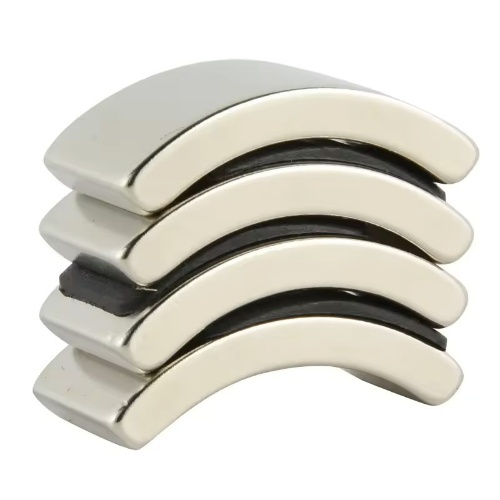
Magnets seem almost alive in the way they hold or drop a load, but their hidden weakness is something you can feel in a hot workshop. Inside any magnet, countless microscopic regions called domains align like tiny compass needles. Heat makes the atoms vibrate more aggressively, and that vibration scrambles the neat alignment. The result isn't dramatic all at once—just a slow fade in pull strength that often goes unnoticed until a fixture slips or a sensor gives a weak reading.
For most common neodymium and ferrite magnets, the loss is reversible up to a point. Cool them back down and the domains can reorder, restoring much of the original strength. Push past the material's Curie temperature, though, and the damage becomes permanent: the magnetic structure effectively collapses and won't return on its own. That's why even brief exposure to a torch flame or a powder-coating oven can ruin a magnet that looked perfectly fine on the outside.
Engineers often account for this by checking the magnet's maximum operating temperature, not just its room-temperature rating. A grade that performs brilliantly at 20°C may lose a third of its pull at 80°C, even if it never reaches the Curie point. When choosing magnets for motors, brakes, or holding fixtures, the real question is rarely "how strong is it?" but rather "how strong will it stay when things heat up?"
Neodymium Grade Numbers: N35, N42, N52—Marketing or Meaning?
The numbers after the N are not arbitrary, but they also don't tell the whole story. N35, N42, and N52 refer to the maximum energy product in mega-gauss-oersteds, a measure of how much magnetic energy a material can store. Higher numbers do mean a stronger magnet—assuming identical shape, size, and testing conditions. Yet real-world performance depends on geometry, temperature, and coating, which the grade alone never captures.
A lot of marketing leans hard on the biggest number, but N52 is not always the smart choice. It costs noticeably more, is more brittle, and loses its edge faster as temperatures climb. Many commercial N52 magnets fall short of the labeled value due to loose manufacturing tolerances. For most holding, sensing, or latching tasks, a well-made N42 will match or beat a mediocre N52 at a fraction of the price.
The real question is whether the supplier can back up the grade with a demagnetization curve and batch test data. Temperature ratings—like the SH or AH suffixes—often matter more than the N number for anything operating above room temperature. Grade numbers do carry meaning, but treating them as a simple quality score is where marketing quietly replaces physics.
Samarium Cobalt for Servos: Paying More to Avoid Mid-Run Failure
A servo running through a demanding production cycle has no tolerance for a magnet that loses its nerve halfway. Standard neodymium magnets, while cheaper and more powerful at room temperature, begin to shed performance as heat builds up inside the motor housing. Once the temperature climbs past their comfort zone, the magnetic field weakens, torque drops, and the control loop has to work harder to maintain position. For a pick-and-place line or a CNC spindle, that kind of drift can turn a finished part into scrap without any obvious warning.
Samarium cobalt behaves differently. Its magnetic properties stay remarkably stable across a wide temperature range, and it resists demagnetization far better under thermal stress. That consistency means the servo’s torque curve remains predictable from cold start to hours into a shift. The upfront cost per magnet is higher, sometimes significantly so, but the alternative is a failure that may only show up when the motor is buried inside a machine, surrounded by tooling and waiting for the next workpiece.
Engineers who specify samarium cobalt aren’t usually chasing peak torque figures on paper. They’re buying insurance against the kind of mid-run failure that halts production, requires a teardown, and erodes confidence in the entire line. Paying more up front is a deliberate trade: less raw magnetic strength than neodymium, but almost none of the thermal anxiety. In applications where downtime costs more than the motor itself, that trade makes the decision almost automatic.
Magnet Geometry Hacks: Pole Shaping and Segmentation Without Redesign
Pole shaping often comes down to minor geometric tweaks that carry disproportionate influence. A small chamfer on the pole edge, a radius instead of a sharp corner, or a shallow relief cut can locally shift where the flux saturates first. This nudges the field profile enough to reduce cogging, smooth torque ripple, or widen a sensor’s linear range without touching the rest of the design.
Segmentation works on a different lever. Splitting a single magnet into several shorter blocks with controlled gaps changes the effective magnetic length and lets you spread thermal and mechanical stress more evenly. Those air gaps also interrupt eddy current paths, which matters at higher speeds. The best part is that each segment can be adjusted independently, so field tuning becomes a matter of swapping or repositioning pieces rather than re-cutting the whole part.
Combining both tricks gives a surprisingly broad tuning range. You can profile the pole face to set the base field shape, then use segmentation to handle high-frequency loss or mechanical constraints. This approach often reveals that a “bad” magnet geometry isn’t actually bad; it just needs a few targeted edits instead of a full redesign.
Datasheet Truths: Coercivity, Remanence, and Real-World Performance
Most engineers treat coercivity and remanence as if they were fixed constants grabbed from a datasheet table. In practice, those numbers come from ideal test conditions, not from the messy operating environment where temperature shifts, mechanical stress, and demagnetizing fields quietly rewrite the rules.
Coercivity, for instance, is not a single value but a curve that depends heavily on how fast the field reverses and what temperature the magnet actually reaches in service. A datasheet might list HcJ at room temperature, yet a motor running at 120°C can lose a meaningful chunk of that resistance simply because thermal energy helps domains flip earlier.
Remanence tells a similar story. The residual flux density after saturation looks impressive on paper, but once the magnet is assembled into a circuit with air gaps and nearby steel, the working point shifts down the demagnetization curve. Real-world performance is less about the headline numbers and more about how those values degrade together under load.
FAQ
The biggest difference usually comes down to batch-to-batch consistency, the shape of the demagnetization curve, and how much the magnetic flux drops as temperature climbs. Standard grades may look fine on a data sheet at room temperature, but a high-performance choice like N45SH or N48H holds its usable flux under real thermal load, and the squareness of its BH curve means the motor keeps predictable torque even during aggressive current peaks.
Not always. Neodymium is strong, but ordinary grades start losing strength irreversibly above roughly 80-100°C depending on the permeance coefficient. For hot-running servos, you need a high-coercivity grade such as N42UH, N48EH, or even a samarium cobalt magnet. The higher the intrinsic coercivity, the better it resists demagnetization when the windings get hot and the drive pushes high current.
They affect it directly. A simple parallel-magnetized arc can create a more trapezoidal air-gap field, which tends to produce higher cogging and torque ripple. Using radial or sinusoidal magnetization, segmenting the magnet ring, or adding a slight skew to the rotor can smooth the flux waveform significantly. The trade-off is that more complex magnetization fixtures and segmented assemblies raise manufacturing cost.
When the rotor is going to live above 150-180°C, when you need very low flux change per degree Celsius, or when the motor will be exposed to corrosive environments without a sealed housing. Samarium cobalt has a remanence temperature coefficient around -0.03%/°C versus roughly -0.12%/°C for neodymium, and it doesn't require the same protective coating. The downsides are brittleness, lower energy product, and generally higher cost.
Yes, and it's usually a combination of heat, reverse magnetic fields, and mechanical stress. If the operating point moves beyond the knee of the demagnetization curve during a high-current fault or a hot stall, the loss is permanent. Corrosion can also eat away the surface and reduce the effective magnetic volume. Good design keeps the magnet's working point well above the knee, even under worst-case temperature and current.
Arc radius, thickness variation, and coating uniformity matter more than people expect. A few microns of thickness variation across a magnet segment can create an asymmetric air gap, leading to unbalanced magnetic pull and vibration. Batch-to-batch spread in remanence and coercivity also affects how consistently the motor performs. If your servo needs tight velocity ripple, ask for tighter magnetic tolerance classes, not just dimensional ones.
Because the coating thickness changes the final rotor dimensions and the air gap, and some coatings can outgas or flake in vacuum, oil-cooled, or high-vibration applications. A flaking nickel or epoxy layer can release particles that damage bearings or encoders. It also affects the thermal path from the magnet to the rotor iron, so the wrong coating choice can actually make the magnet run hotter than expected.
Sintered magnets give you the highest energy product and torque density, but they're rigid, brittle, and can suffer eddy-current heating in high-frequency fields. Bonded magnets can be molded into complex ring shapes with tight dimensions, and their higher electrical resistivity reduces eddy-current losses at high speeds. The trade-off is a much lower magnetic performance, so they're usually reserved for compact or very high-RPM designs where low inertia matters more than peak torque.
Conclusion
In servo motors, the magnet choice isn't a spec-sheet afterthought—it's the silent dictator of torque, heat tolerance, and mid-run reliability. Rare earth neodymium magnets dominate when you need brute force in a compact rotor, but their ferrite cousins still earn a place in cost-sensitive, low-speed applications where thermal headroom isn't a daily battle. The real differentiator, though, is how that magnet behaves when the servo gets hot: neodymium's strength falls off a cliff past 80°C unless you pick a high-coercivity grade, while ferrite's weaker field actually becomes more stable as things warm up. This is why smart engineers stop obsessing over the N35 vs N52 marketing numbers and start asking about the intrinsic coercivity (Hci) and remanence (Br) on the actual datasheet—two numbers that predict a motor's real-world survival far better than any grade label.
For servo applications that endure repeated thermal cycling or cramped enclosures, samarium cobalt is the expensive but often justified choice: it laughs at 150°C and barely loses strength, making it the anti-failure insurance for precision automation where a stalled axis costs more than the magnet upgrade. Beyond chemistry, magnet geometry quietly unlocks performance without a full motor redesign—segmented poles, skewed magnets, and subtle pole shaping can slash cogging torque and smooth out velocity ripple, tricks that raw material grade alone can't buy. The practical takeaway? Ignore the glossy N52 hype and match your magnet to the servo's thermal reality, mechanical load profile, and failure cost. A mid-grade neodymium with smart segmentation often outperforms a premium grade with a naive ring magnet, and a samarium cobalt rotor can outlive three cheaper motors in a hot, high-duty-cycle line. None of this shows up in a headline spec, but it's exactly what separates a servo that works for years from one that quietly loses torque after a thousand cycles.
Contact Us
Contact Person: Kelvin Lo
Email: [email protected]
Tel/WhatsApp: 0769-88561131
Website: https://dawamagnetic.com/